What a Schwartz Round Taught Me About Leading Under Pressure (in Any Industry)
By Carolyn Cowperthwaite · Published 6 November 2026 · Updated 20 November 2026
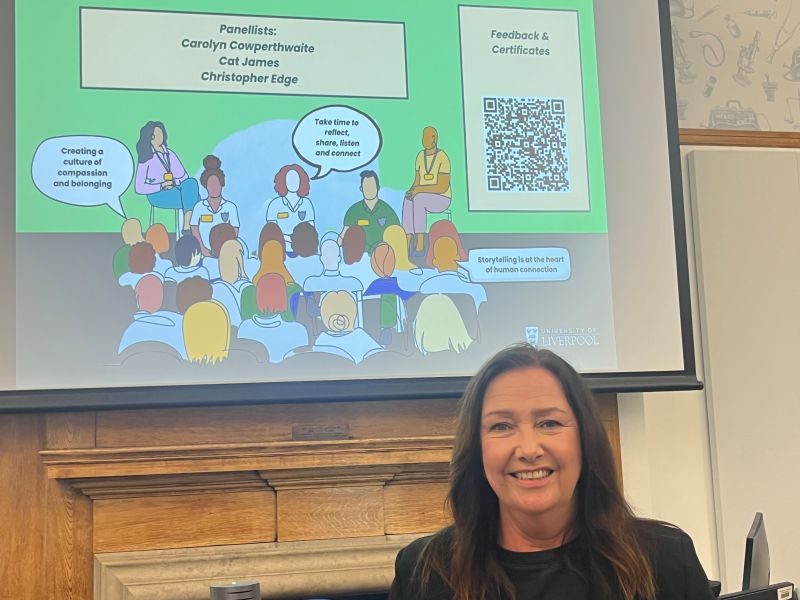
A Schwartz Round is a structured forum where healthcare staff talk openly about the emotional and psychological impact of their work, rather than the clinical problems. I recently served as one of three panellists at a Schwartz Round hosted by the University of Liverpool, in a room full of medics, nurses and allied health professionals.
Our stories were rooted in medicine. The lessons apply to anyone who leads under pressure.
What is a Schwartz Round?
Schwartz Rounds are voluntary, confidential, multidisciplinary meetings, usually an hour long, where staff share the human side of caring for patients. They were developed by the Schwartz Center for Compassionate Healthcare in Boston in the 1990s and came to the UK and Ireland in 2009.
The Point of Care Foundation describes them as a space to explore the challenges and rewards of providing care, not to solve problems.
Nobody fixes anything in a Round. That is the point. A small panel tells true stories, and the room reflects on what those stories stirred up in them.
What we talked about in Liverpool
I shared the panel with Cat James and Christopher Edge. Between us, the stories covered pandemic burnout, managing complex trauma and leading through high-stakes family crises.
The slide behind us summed up the day: storytelling is at the heart of human connection, and the work is creating a culture of compassion and belonging.
I spent 38 years in the NHS, more than a decade of it in senior management, and led frontline teams through the pandemic. That room reminded me how much of leadership is carried in silence. It is also why my executive coaching starts with the human side of the job, not just the strategy.
High pressure creates the same human challenges in every industry
The core takeaway reaches far beyond hospital walls. A hospital ward, a law firm, an accountancy practice, a logistics operation, an energy company, a boardroom: the dynamics are identical. Three of them came up again and again.
1. Emotional depletion
When professionals give everything to their clients, cases or crises all day, they often go home with empty reserves. Their families get what is left. They get even less.
Most leaders I work with don't notice this happening until it has been going on for months.
2. Psychological safety
Real resilience isn't about powering through. High-performing teams thrive when people feel safe enough to admit they are struggling before a breakdown, not after one.
A Schwartz Round builds that deliberately: one protected hour where saying "that case got to me" is normal. Most workplaces outside healthcare have nothing like it, so strain stays hidden until someone goes off sick or hands in their notice.
If your leadership team avoids those conversations, team coaching is one way to build the trust that makes them possible.
3. Leading in chaos
When tension peaks, true leadership isn't about hiding behind policy. It is about staying grounded, handling intense stakeholder friction and protecting your team.
That is usually when the hardest calls get made too. I've written separately about making hard decisions without losing your humanity.
Where executive coaching fits
In every field, people hit moments where stress, high stakes and heavy responsibility collide. Coaching gives leaders in healthcare, corporate, legal and commercial roles the emotional intelligence, boundaries and strategic clarity to lead through that pressure without burning out themselves or their teams.
And when something lands that can't wait for the next session, a 30-minute Laser Call, usually booked within 24 hours, gives you a sounding board in the moment.
I've also written about the "Do I Belong?" Schwartz Round I spoke at, and what it says about belonging in a senior leadership transition.
Thank you to Julie Bilboe-Crane, the University of Liverpool and everyone who attended for such a rich, honest conversation.
If you lead under this kind of pressure, book a free discovery call.
Frequently asked questions
What is a Schwartz Round?
A Schwartz Round is a voluntary, confidential, multidisciplinary forum, usually lasting an hour, where healthcare staff discuss the emotional and social impact of their work. A small panel shares real stories and the audience reflects on them. The aim is support and connection, not solving clinical problems.
Who can attend a Schwartz Round?
Rounds are open to all staff in an organisation, clinical and non-clinical. They run in hospitals, hospices, universities and other care settings, and students take part too, as they did at the University of Liverpool Round where I spoke.
Do Schwartz Rounds actually work?
A 2018 study led by Professor Jill Maben found that regularly attending Rounds halved the rate of psychological distress among staff. A 2017 national evaluation also found attendees felt less stressed and better able to show compassion to patients.
What can leaders outside healthcare learn from Schwartz Rounds?
Pressure creates the same human strain in every sector, and teams perform better when people can admit they are struggling early. Leaders in law, finance, logistics and energy face the same emotional depletion and need the same psychological safety.
How does executive coaching help with emotional depletion?
Coaching gives you a confidential space to see where your energy goes, set boundaries that hold and plan how you lead through pressure. The aim is sustained high performance without burning out you or your team.